What does a rotary hammer drill do: Best guide
A rotary hammer drill is not a drill in any mechanical sense. It's a pneumatic impact tool that also spins, and the name is genuinely misleading. If you've picked one up wondering what it actually does that a regular drill can't, you're asking the right question.
Manufacturer specs as of 2026 show consumer models delivering 1.5 joules of impact energy, while pro units hit 17 joules. That's a ten-fold jump in axial force per blow. The mechanism behind that number is where things get interesting, and it's not what most people picture.
Quick Answer
A rotary hammer drill spins and hammers at the same time. A sealed pneumatic air-valve drives each axial impact. Rotation runs independently of the hammer stroke.
That makes it 3 to 5 times faster on concrete. It also chisels in hammer-only mode.
It's Not a Drill: Here's What a Rotary Hammer Actually Does
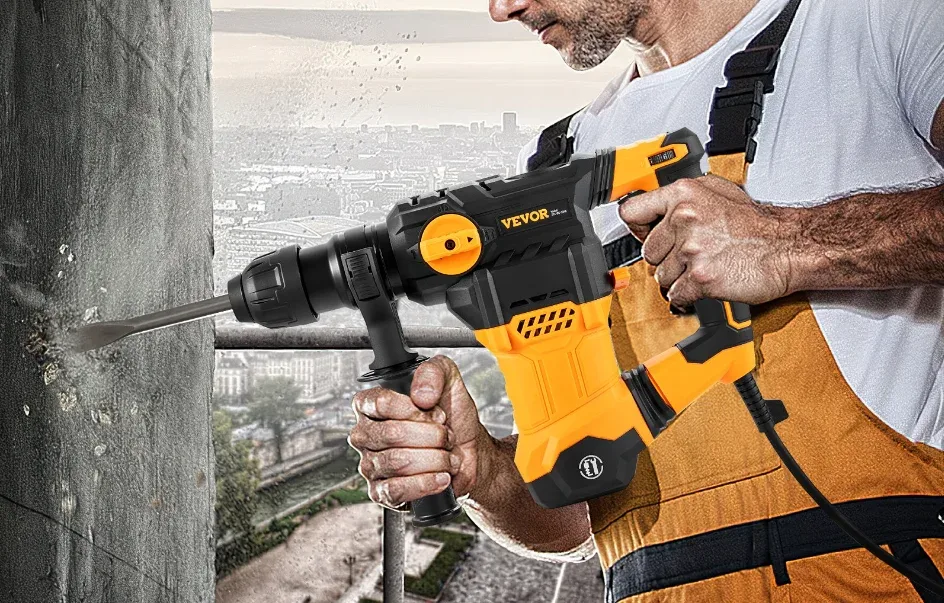
The term "rotary hammer drill" is a category error baked into the name. A standard drill cuts with rotation. A carbide-tipped masonry bit grinds the material.
A rotary hammer does something different. It delivers a pneumatic blow axially into the bit while spinning it.
That combination shatters aggregate in concrete. You use it for anchor bolt holes through rebar-embedded slabs, core passes through brick, and chiselling old mortar joints. The tool absorbs the shock internally, so your wrist doesn't take the punishment.
The key distinction: the hammer action comes from compressed air in a sealed chamber, not from a spring-loaded bit bouncing off the material. That's why it outperforms every other hand-held impact option on dense masonry. And because concrete drilling generates crystalline silica, OSHA's construction standards set the PPE and dust-control rules you'll follow on any job site.
The Air-Valve Mechanism: Why "It Hammers and Spins" Is Wrong
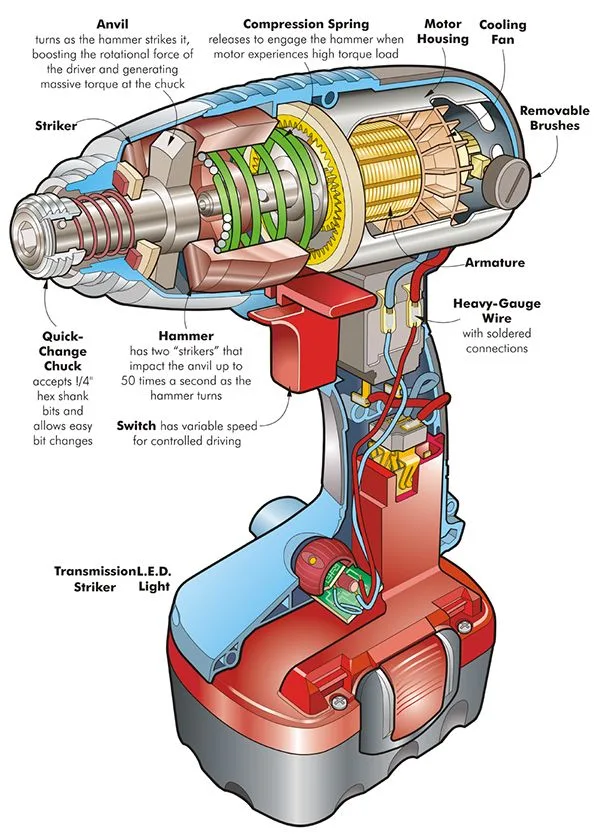
The phrase "it hammers and spins" makes it sound like two independent features running in parallel. They're not. The rotation actually powers the hammer.
Here's the sequence. The motor spins a rotor that carries a cam. That cam drives the piston back and forth in the cylinder.
As the piston moves forward, it compresses a pocket of trapped air. That air acts as a valve and a spring in one.
When the piston reverses, the compressed air pushes it forward again in a rapid free-throwing stroke. The bit gets the blow. Per ISO 24348 testing methodology, that's how manufacturers measure and certify the axial impact energy you see on spec sheets.
This is why the tool can deliver 5.5 or 17 joules without a spring pack. The air-valve does the work.
What's Inside the Housing: Piston, Diaphragm, and SDS Chuck
Strip the casing off and three components do nearly all the work:
- Piston and cylinder: The reciprocating mass. Its stroke length and weight determine impact energy. Heavier piston, bigger blow.
- Air-valve diaphragm: A thin rubber or polymer membrane that seals the compressed-air pocket. Not serviceable on most units. When it fails, you replace the whole assembly.
- SDS chuck: A collet-free bit holder with two or four open slots. The bit seats by geometry, not by a clamp. That's what lets it flex slightly under impact instead of cracking.
The motor (brushed or brushless) drives rotation. A gearbox steps it down to 0 to 4,600 rpm. A mode selector on the body switches between rotary-hammer, hammer-only, and drill-only.
Rotary Hammer vs. Hammer Drill: The One Diagram That Explains Everything
A hammer drill is what most people mean when they say "I need to drill into a wall." It's lighter, cheaper, and fine for brick and soft block. The moment you hit dense concrete or rebar, it struggles.
| Rotary Hammer | Hammer Drill | |
|---|---|---|
| Impact source | Pneumatic air-valve, axial | Spring-loaded, lateral |
| Impact energy | 1.5 to 17+ joules | 0.4 to 1.2 joules |
| Bit system | SDS-plus / SDS-max | 13 mm round shank |
| Best material | Concrete, rebar, masonry | Brick, soft block, tile |
| Chiselling mode | Yes | No |
| Typical weight | 2.5 to 9+ kg | 1.5 to 2.5 kg |
The lateral strike of a hammer drill scatters about 70% of its impact energy sideways. Only roughly 30% reaches the bit tip axially. A rotary hammer sends nearly all of it straight into the material.
If you're drilling into a brick garage wall once a year, a hammer drill is fine. If you're cutting anchor passes through a concrete slab with 12 mm rebar at 50 mm depth, you need the pneumatic axial blow. No other hand-held tool gets you there at a reasonable pace.
SDS-plus vs. SDS-max: Why Your Standard Bits Won't Work
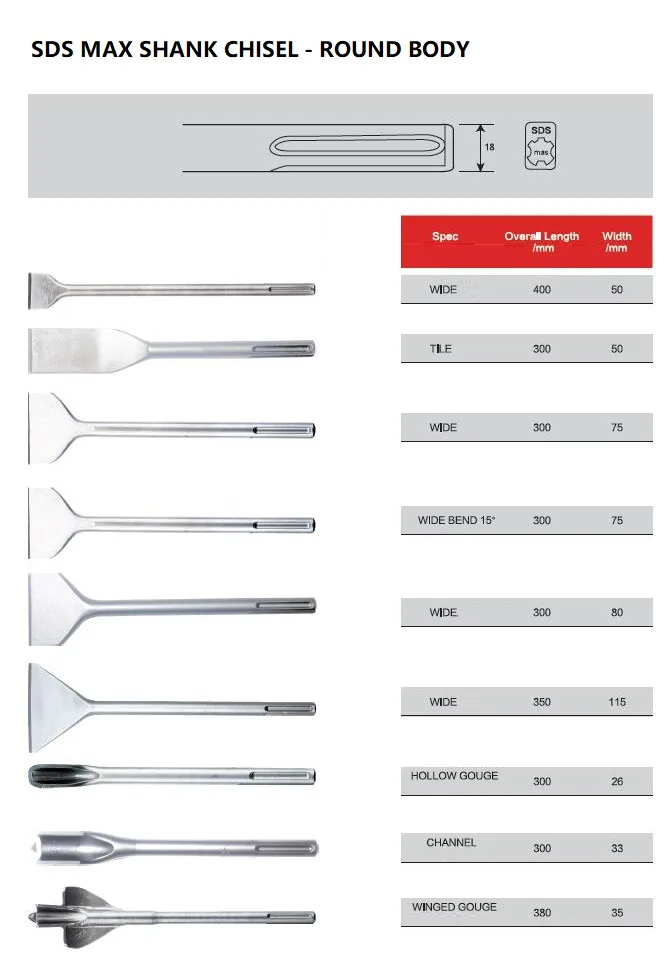
You can't drop a standard 13 mm round-shank masonry bit into a rotary hammer. The SDS chuck has no collet. It holds the bit through two (SDS-plus) or four (SDS-max) open slots in the shank.
A round bit just slides out under the first impact.
SDS-plus handles diameters from 4 mm to 28 mm. It's the consumer and light-pro standard. SDS-max covers 16 mm to 44 mm (some demo units reach 52 mm).
The shank is longer, the slots are closed, and retention is firmer for higher impact loads.
Buy the tool, buy the matching bit set. A 14 mm SDS-plus bit is the workhorse for most anchor bolt jobs. A 25 mm SDS-max bit handles sleeve anchors through load-bearing walls.
Mismatching the system means the bit ejects mid-stroke.
Three Modes, Three Different Jobs
The mode selector on the side of the housing isn't a gimmick. It physically disconnects the rotation gear from the piston, and that changes the tool's entire job.
- Rotary-hammer: The default for drilling. You spin and you blow. Use this on concrete, masonry, or anything with aggregate.
- Hammer-only (chisel mode): Rotation stops. The piston keeps pounding. You swap in a chisel and run it flat against the surface. This is how you crack old adhesive, split tile, or break a mortar joint.
- Drill-only: No impact. Pure rotation. Use this on wood, metal, or soft drywall where the axial blow would just crater the material.
One thing people miss: in chisel mode, you can't use an SDS drill bit. The shank geometry won't seat. You need a chisel with the matching slot profile.
Leave the drill bit in and pull the trigger, and it ejects under the first strike.
What You're Actually Drilling: Concrete, Rebar, and Everything in Between
Concrete isn't a single material. A garage slab is C20 with 8 mm aggregate. A load-bearing wall might be C40 with 16 mm aggregate and 12 mm rebar at 50 mm cover.
The bit and impact energy you need shift with each variable.
- Soft masonry (brick, block, thin tile): A 1.5 J consumer unit handles it in seconds. A hammer drill would work here too.
- Standard concrete, no rebar (3 to 5 J): The sweet spot for anchor bolt work and HVAC pipe passes. A 14 mm SDS-plus bit at medium speed gets through 300 mm of C30 in about two minutes.
- Rebar-embedded concrete (5.5 to 10 J): You'll feel the bit skip when the carbide tip hits steel. Back off the feed, let the impact grind through, and advance again.
- Heavy demo, thick slabs, dense stone (10 to 17+ J): SDS-max territory. You're looking at 28 mm and up, and the tool weighs 6 to 9 kg.
The rule: match impact energy to material density, not to hole diameter. A 28 mm hole in soft brick doesn't need 10 joules. A 10 mm hole through rebar-packed C50 does.
Step-by-Step: Seating a Bit, Setting Depth, and Firing Your First Hole
Getting the bit in correctly takes ten seconds. Skipping that step costs you the bit, and sometimes the chuck.
- Select the bit. SDS-plus for 4 to 28 mm holes. SDS-max for 16 to 44 mm. Check the shank slots match your tool's chuck.
- Insert the bit. Push it in until the locking collar snaps forward. You'll feel a detent and hear a small click. If it doesn't snap, the bit is seated wrong.
- Set the depth stop. Slide the metal sleeve up the bit to your target depth. Collar it against the housing. This stops the bit from punching through into a cavity.
- Pick your mode. Rotary-hammer for drilling. Hammer-only for chiselling. Drill-only for wood or metal.
- Brace and feed. Two hands. One on the rear grip, one on the front handle. Let the impact do the cutting. Light, steady pressure.
- Back the bit out every 50 mm. Twist it slightly to clear cuttings from the flutes. A packed bit generates heat and stalls.
That's the whole process. No warm-up, no special technique. The pneumatic mechanism is consistent from the first stroke.
Specs That Matter (Impact Energy, Not RPM)
RPM tells you how fast the bit spins. It doesn't tell you how fast you're making a hole. On a rotary hammer, impact energy in joules is the number that correlates with drilling speed.
| Spec | What it means for you |
|---|---|
| Impact energy (J) | Force per blow. Higher = faster in dense material |
| No-load RPM | Rotation speed. Lower is better for large bits |
| Torque (Nm) | Matters only in drill-only mode on wood or metal |
| Motor power (W) | Sustains impact rate under load |
| Bit diameter range | Set by the SDS system, not the motor |
In our research across manufacturer spec sheets, a 3 J SDS-plus tool drilling 14 mm in C30 concrete hits roughly 30 to 60 mm per minute. Double the impact energy to 6 J and you push past 80 mm per minute. RPM barely changes between those two tools.
The joules do the work.
If you're shopping, look at impact energy and motor wattage first. A brushless motor at 1,000 W sustains impact rate longer than a brushed unit at 700 W before the piston loses its free-throw.
The Mistakes That Crack Bits and Void Warranties
Most bit failures trace back to two or three specific operator errors. None of them are subtle.
- Overfeeding. Slamming the tool into the wall. The piston can't recover its stroke fast enough. The bit loads in torsion and the carbide tip snaps. Let the impact cycle run at its natural rate.
- Wrong mode, wrong bit. Running a chisel in rotary-hammer mode. The chisel has no carbide spiral, so it grinds, heats, and delaminates. Switch to hammer-only.
- Running the tool dry for months. The air-valve diaphragm stiffens. Before first use after storage, fire the trigger in free-air for about 20 seconds to flex it back into shape.
- Using a standard round-shank bit in the SDS chuck. It won't stay in. Under the first impact, it pops out and can strike your face. This is the most common safety incident with a new rotary hammer.
- Ignoring the depth stop. Drilling through a 150 mm slab into the room below, or through into a cavity with live wiring. Measure, set the stop, check it twice.
Bosch, Hilti, and Makita all list excessive feed force and incorrect bit use as warranty-void conditions. A cracked piston housing runs $150 to $300 to repair. A 14 mm bit costs $8.
The math is clear.
Dust, Decibels, and the OSHA Stuff You Can't Skip
Drilling concrete generates respirable crystalline silica. OSHA's 29 CFR 1926.1001 sets a 50 μg/m³ 8-hour TWA for respirable silica. A single 14 mm hole through C30 concrete can push local airborne concentrations past 1,000 μg/m³ without control.
You need three things before the bit touches the wall:
- Respiratory protection: NIOSH-approved N95 at minimum, P100 for sustained work. A hardware-store dust mask won't hold the particulate.
- Dust capture: A HEPA vacuum on the tool's dust port, or a wet-drill method where the surface allows. NIOSH's silica guidance lays out the engineering controls that keep you under the limit.
- Hearing protection: Most rotary hammers hit 95 to 105 dB(A) at the operator's ear. ANSI Z49.1-rated earplugs or muffs prevent cumulative damage on a half-day shift.
In the UK, HSE and the Construction (Design and Management) Regulations 2015 require a written silica control plan for any trade drilling concrete more than ten hours per week. Check your jurisdiction before you start.
Why Your Tool Seizes After Sitting in the Garage for Months
The air-valve diaphragm is a sealed elastomer. Left at room temperature for six-plus weeks, it stiffens and the internal spring tension drops. You pull the trigger, the piston half-strores, and the tool feels dead.
The fix is mechanical, not electrical. Fire the trigger in free air (no bit loaded, no wall contact) for 15 to 20 seconds. The piston cycles flex the diaphragm back to its working shape.
If your tool is a brushed model, pull the side panels and check the carbon brushes. Below 5 mm, the brush loses contact with the commutator and the motor stalls under load. Replace them in pairs.
Store the tool with the trigger locked and the mode selector in drill-only. That keeps the piston at rest and the diaphragm from holding a partial compression.
When You Don't Need One (and What to Use Instead)
A rotary hammer is overkill for most residential jobs. You don't need one if:
- You're drilling into soft brick, plaster, or thin block. A hammer drill with a 13 mm round-shank masonry bit gets the job done in half the weight.
- You're anchoring into wood or metal. A standard cordless drill with HSS or cobalt bits is the right tool.
- You need a hole bigger than 44 mm. That's core drill or hydraulic hammer territory.
- You're in a tight overhead space. The 8 kg pro units are unwieldy. A 2 kg hammer drill clears the ceiling track easier.
If your only job is one anchor bolt in a garage wall every year, rent a 3 J SDS-plus unit. That's $25 to $40 a day. You break even against a $350 purchase in about two jobs.
Quick Reference: Every Mode, Bit, and Job at a Glance
| Mode | Bit type | Typical job | Impact energy needed |
|---|---|---|---|
| Rotary-hammer | SDS-plus 14 mm | Anchor bolt, C30 slab | 1.5 to 3 J |
| Rotary-hammer | SDS-max 25 mm | Sleeve anchor, load-bearing wall | 5.5 to 10 J |
| Hammer-only | SDS-plus chisel (flat or pointed) | Crack adhesive, split tile | 3 J+ |
| Drill-only | 13 mm round shank (HSS, cobalt) | Metal, drywall, timber | N/A |
| Drill-only | 13 mm round shank (cobalt) | Steel plates, exposed rebar | N/A |
Two rules of thumb. For drilling, match the bit diameter to the anchor manufacturer's spec, not to the biggest bit the tool accepts. For chiselling, start with a flat chisel at the wide end of the joint and work inward.
A pointed chisel is for breaking, not for guiding.
Frequently Asked Questions
Can a rotary hammer drill use standard drill bits?
No. The SDS chuck has no collet. A 13 mm round-shank bit won't seat in the two-slot or four-slot shank geometry.
It ejects under the first impact. Use only bits with the matching SDS-plus or SDS-max slot profile.
How is a rotary hammer different from a hammer drill?
A hammer drill strikes the bit laterally with a spring-loaded mechanism. A rotary hammer drives the piston axially through a sealed pneumatic air-valve. That axial blow delivers 3 to 5 times more energy into the material and handles rebar-embedded concrete that bounces a hammer drill.
What does SDS-plus stand for and why does it matter?
SDS is a Bosch original meaning "drill, hammer, fast." The two open slots in the shank let the bit flex slightly under impact. That flex absorbs shock instead of transferring it to the carbide tip, which is why SDS bits last 2 to 3 times longer than round-shank equivalents.
Can I use a rotary hammer in wood or metal?
Only in drill-only mode, and even then it's the wrong tool. The weight and torque curve are tuned for masonry. A standard cordless drill is lighter, faster, and won't crater the surface.
Running chisel mode on wood or metal will damage both the workpiece and the bit.
How often should I replace the carbon brushes?
Check them every 200 to 300 hours of continuous use on a brushed model. When the brush drops below 5 mm, the motor stalls under load and the commutator scores. Brushless models skip this entirely, which is why they carry a 20 to 30% price premium.
Why does my rotary hammer feel slow in concrete?
Three usual causes. You're in the wrong mode (drill-only instead of rotary-hammer). The bit is clogged with compacted cuttings.
Or the impact energy is too low for the material density. Switch modes, back the bit out and twist it clear, and confirm the tool's joule rating against the concrete grade.