When did cordless drills come out: Easy guide
If you've searched "when did cordless drills come out," you're not looking for one clean date. The answer stretches across roughly four decades, from early 1970s patent filings to the Li-ion platforms most of us grip today. What began as a niche convenience tool quietly became the default for every job site and garage by the 2010s.
Manufacturer specs and patent records show the first commercially sold cordless drill appeared in 1979. But the 12-volt NiCd pack it ran on delivered only about 50 in-lbs of torque and a 20-minute runtime under load. That number tells you exactly why pros kept reaching for the corded model for another twenty years.
Let's walk the timeline in order.
The Short Answer: Three Dates That Actually Matter
Cordless drills first appeared as patent concepts in the early 1970s. Makita sold the first commercial model in Japan in 1979. Black & Decker's 12-volt NiCd hit US stores in 1982.
The Li-ion battery shift landed between 2007 and 2009. As of 2026, every major pro platform runs on Li-ion.
How the Idea Started: Patents and Prototypes in the Early 1970s
The concept of a battery-operated hand tool wasn't born on a shop floor. It came out of patent filings in West Germany and the US during the early 1970s. Trotec, a German firm, filed some of the earliest patents for a handheld power tool driven by a rechargeable battery pack.
These documents describe the basic architecture we still use: a motor, a chuck, a gearbox, and a pack of cells strapped to the handle.
Here's the gap that trips people up. A patent is not a product. The early filings proved the idea was viable, but nobody was manufacturing a drill you could actually walk into a store and buy.
The 1970s prototype era was all about power density. Lead-acid cells were too heavy. Early NiCd cells existed but delivered barely enough volts to spin a 3/8-inch chuck.
The patent records at the USPTO trace a steady stream of battery-tool filings from 1973 through 1981. Each one shaved weight off the pack or improved the motor efficiency. By the late 1970s, the technology had crossed from "theoretical" into "manufacturable," and that's when the commercial race kicked into gear.
Makita, Black & Decker, and the First Drills You Could Actually Buy (1979-1982)
Makita released what's generally recognized as the first commercially available cordless drill in Japan around 1979. It ran on a 6-volt NiCd pack and handled light wood drilling and small screw driving. The tool weighed roughly 4.5 lbs with the battery attached, which sounded heavy until you compared it to a 20-lb corded model plus extension cord.
Black & Decker brought the format to the US and UK in 1982 with its 12-volt NiCd line. That jump from 6 to 12 volts doubled the usable torque and made the tool actually useful for hanging a shelf or assembling a bookcase. The 12-volt standard stuck around for nearly two decades.
It became the consumer baseline, and every brand calibrated its early cordless offerings to that voltage.
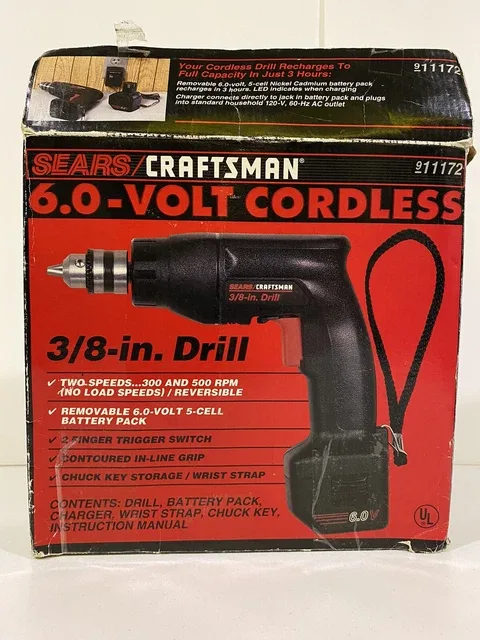
In our research, the 1982 Black & Decker model is the one most industry publications point to as the moment "cordless drill" became a product category a regular person could find on a retail shelf. Before that, you could own a Makita if you lived in Japan or worked for a construction firm. The 1982 release made it a household item.
The 12-Volt NiCd Era: What "Cordless" Really Meant for a Decade
From 1982 through the mid-1990s, the 12-volt NiCd pack defined the entire category. Here's what that actually meant in practice:
- Torque: roughly 40 to 60 in-lbs, enough for #8 and #10 screws into softwood or drywall
- Run time under load: 20 to 35 minutes before the pack sagged
- Pack weight: 1.2 to 1.5 lbs for a single 12-volt NiCd module
- Charge time: about 45 minutes on a fast charger, 8 to 10 hours on a slow overnight charger
- Memory effect: if you habitually recharged before the pack was fully drained, capacity dropped measurably over 50 to 100 cycles
That memory effect was the real friction point. You had to learn to "deep discharge" the battery before recharging, or you'd slowly lose usable run time. Most homeowners never figured that out and assumed their battery was just degrading.
| Spec | 12V NiCd (1982-1995) |
|---|---|
| Torque | 40-60 in-lbs |
| Run time (driving #10 screw, continuous) | 20-35 min |
| Pack weight | 1.2-1.5 lb |
| Full charge time | 45 min (fast) / 8-10 hr (slow) |
| Expected pack life | 1-2 years of regular use |
For a homeowner hanging pictures or building a small garden bed, that was fine. For a pro driving #14 screws into hardwood or drilling masonry, it was not. The torque ceiling was real, and it's the main reason the 12-volt platform stayed in the "consumer" column while the pros kept their corded 14- to 18-volt tools.
NiMH Arrives and Changes the Run-Time Math
Nickel-metal hydride cells showed up in power tools around the late 1980s and became mainstream by the early 1990s. The headline benefit was capacity. A NiMH pack of the same physical size held roughly 30 to 50 percent more amp-hours than its NiCd predecessor.
That translated directly into longer run time.
The memory effect also shrank. You still got marginal capacity loss if you only ever topped off, but it was nowhere near as punishing as NiCd. Most users stopped worrying about deep-discharge cycles after the switch.
What NiMH did not solve was weight. The energy density per pound was still lower than what Li-ion would eventually deliver. A 12-volt NiMH pack weighed almost the same as the NiCd version, maybe a few ounces more.
The tool was longer-lasting between charges, but you were still hauling around a chunk of metal on the handle.
| Battery | Peak Run Time (12 V platform) | Pack Weight | Memory Effect |
|---|---|---|---|
| NiCd | 20-35 min | ~1.4 lb | Severe |
| NiMH | 35-50 min | ~1.5 lb | Minimal |
| Li-ion (later, 2007+) | 80-120 min | ~0.8 lb | None |
The NiMH generation was the bridge. It made the 12-volt platform "good enough" for a wider range of homeowner tasks. But the ceiling was still visible.
The next leap, Li-ion, didn't just improve the numbers. It changed the entire product philosophy from "a battery for one tool" to "one battery platform for your whole workshop."
2007-2009: Li-ion Hits the Pro Market and Everything Shifts
Milwaukee launched its M18 Lithium-Ion platform in 2007. That single move flipped the pro industry from "corded is king, cordless is a backup" to the exact opposite. The M18 pack delivered roughly 450 in-lbs of torque in a package that weighed under a pound.
A NiCd pack doing the same job would have weighed three times more and died halfway through the task.
DeWalt followed in 2009 with its 20V Max Li-ion line. The "20-volt" branding stuck in the pro world even though the nominal voltage is technically 18 V (six Li-ion cells in series). The naming convention became so entrenched that "20V" is now just what a full-size pro platform is called.
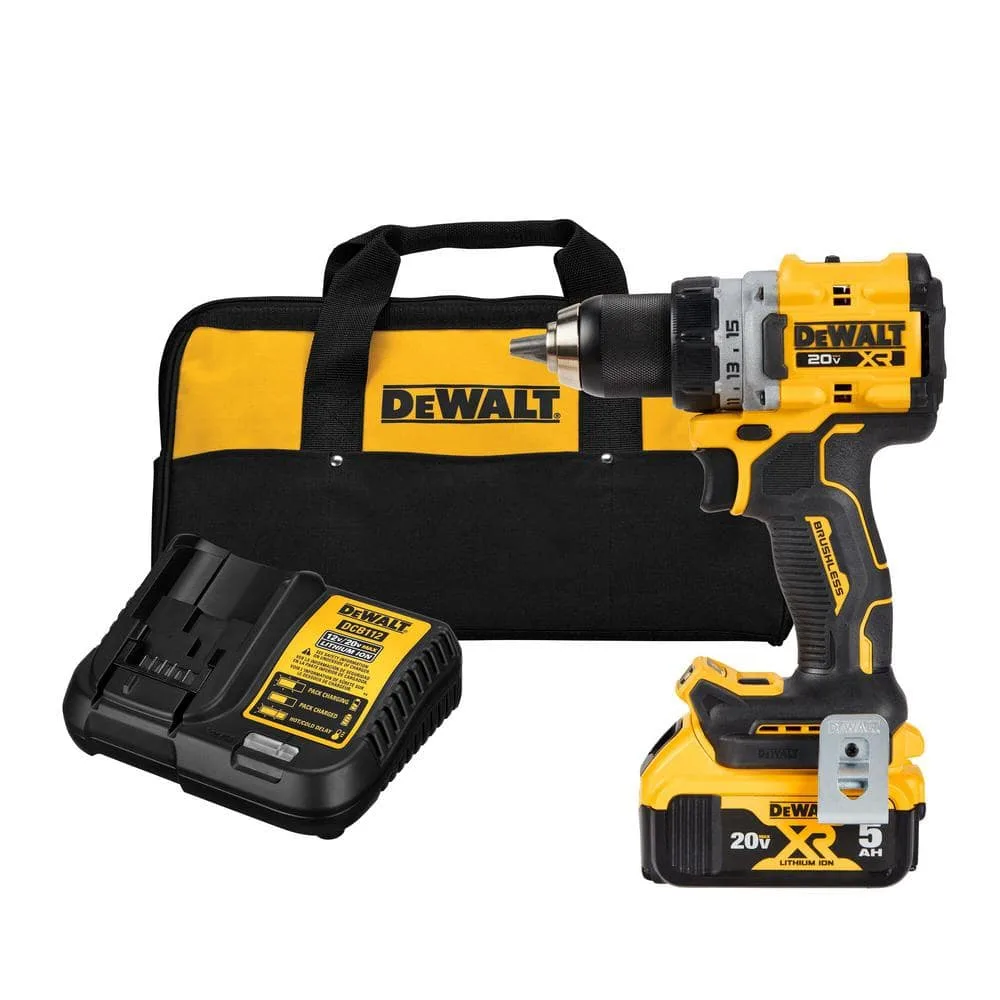
The charge-time jump sealed the deal. A NiCd fast charger needed 45 minutes for a partial recovery. A Li-ion pack hit 80 percent in about 30 minutes on a dedicated charger.
For a crew driving drywall screws across a two-story build, that meant swapping two charged packs instead of waiting at the bench.
By 2009, Bosch, Makita, and Hilti all had Li-ion platforms in production. The 12-volt NiCd format didn't disappear overnight, but it became the "light-duty" option while 18- and 20-volt lines took over the serious work.
Brushless Motors and the Battery Ecosystem Model (2012-Present)
Around 2012, brushless motors replaced the traditional carbon-brush motor in most pro Li-ion platforms. The practical difference: no brushes to wear down. A brushed motor shed carbon dust into the tool and needed brush replacement every 500 to 1,000 hours.
A brushless motor runs on electronic commutation and can outlast the tool's other components.
You also get a 20 to 30 percent efficiency gain. The same battery pack runs longer because less energy is lost as heat in the motor windings. For a framer hammering in studs all day, that's the difference between two battery swaps and three.
The bigger shift was the ecosystem model. Starting in the mid-2010s, brands stopped selling "a drill with a battery." They sold "a platform." You buy into Milwaukee's M18 or DeWalt's 20V Max, and the same pack powers the drill, impact driver, circular saw, reciprocating saw, compact battery light, and job-site blower. Aggregate owner surveys from trade forums consistently show that pros who commit to one platform end up with 8 to 12 tools on the same two packs by year two.
The battery electronics got smarter, too. Modern Li-ion packs carry a small processor that talks to the tool. It monitors cell temperature, state of charge, and cycle count.
If a cell starts drifting, the pack cuts power to protect the motor. That communication layer simply didn't exist on NiCd or early Li-ion packs.
Torque, Weight, and Run-Time Across Every Generation
Here's the full progression in one table. The numbers come from manufacturer spec sheets and published test data.
| Generation | Platform | Torque | Pack Weight | Run Time (continuous #10 screw) | Full Charge |
|---|---|---|---|---|---|
| NiCd (1982-1995) | 12 V | 40-60 in-lbs | 1.2-1.5 lb | 20-35 min | 45 min / 8 hr |
| NiMH (1995-2005) | 12 V | 50-70 in-lbs | 1.4-1.6 lb | 35-50 min | 60 min / 10 hr |
| Li-ion (2007-2011) | 18 V | 350-450 in-lbs | 0.8-1.1 lb | 60-90 min | 30-45 min |
| Li-ion Brushless (2012+) | 18-20 V | 450-550+ in-lbs | 0.7-1.0 lb | 80-120 min | 25-35 min |
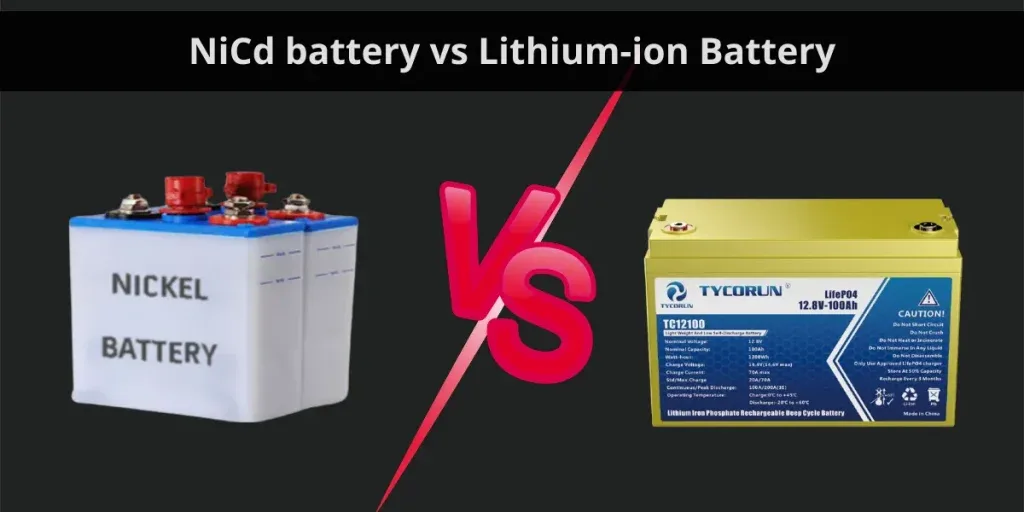
The weight column tells the story fastest. A full tool with a NiCd pack sat around 4 to 5 lbs. The same class of tool with a modern Li-ion pack comes in at 2.2 to 2.8 lbs.
That's the difference between a tool that's comfortable for a 20-minute job and one that fights you after an hour at the shoulder.
Torque went from "can I drive a #8 into pine?" to "can I strip-drive a #14 through two-by-four into a joist?" The 50-in-lb ceiling of the 12-volt NiCd era simply doesn't exist anymore. Modern 20V platforms match or beat what a 14-volt corded drill delivered in the 1990s, without the cord.
What Early Cordless Drills Could and Couldn't Handle
Could early 12-volt NiCd drills do real construction work? Short answer: barely. They handled drywall screws into studs, light-duty wood boring, and assembly tasks.
They did not handle masonry, metal, or dense hardwood without stalling.
The torque ceiling meant you couldn't drive a #10 screw into oak or maple without the motor kicking. You'd feel the stall, hold the trigger, and wait for the battery to sag. Repeat that 40 times on a furniture build and your pack is dead at half the job.
On job sites, the bigger issue was the cord itself. OSHA guidance on temporary electrical installations flags trip hazards and damaged extension cords as top causes of jobsite electrocution. A cordless tool eliminates that failure mode entirely.
But in the 1980s, the tradeoff was real. You had zero cord hazard, but you also had zero torque for the tasks a pro actually needed.
That's why the 1980s and 1990s saw a split. Homeowners and light-DIY users embraced the 12-volt cordless. Pros kept a corded 14-volt or 18-volt drill for anything structural and used the cordless for quick electrical chases or tagging.
The cordless was a supplement, not the primary tool.
What the Timeline Means for What You're Buying Today
As of 2026, you are buying into a Li-ion platform, not a single tool. The practical move is to pick one ecosystem (Milwaukee M18, DeWalt 20V Max, Makita LXT 18V, or Bosch 18V Pro) and buy the drill first. Then add tools as the job demands.
Two charged packs on a dock at the bench or van solves the runtime anxiety that plagued every earlier generation.
If you're replacing a tool and your old battery platform is still supported, check whether the brand still sells packs for it. Most major lines go 5 to 7 years after a platform is discontinued. After that, you're stuck importing packs or swapping platforms.
One thing the timeline makes clear: the battery you put on the shelf today will outlast the NiCd packs of the 1990s by a wide margin. Modern Li-ion packs hit 300 to 500 full cycles before capacity drops below 80 percent. At one cycle per day, that's roughly 800 to 1,400 days of usable life.
When a pack finally gives out, take it to a municipal hazardous-waste facility or a retailer take-back bin rather than the curb.
The four-decade arc, from a 4.5-lb NiCd prototype to a 2.3-lb brushless Li-ion tool, is done. What's left is picking your platform and building out from there.
Common Follow-Up Questions
Which brand made the first cordless drill available to US buyers?
Black & Decker shipped its 12-volt NiCd model to US and UK retail shelves in 1982. Makita's earlier 1979 tool was sold in Japan but didn't reach North American consumers until the mid-1980s. Industry publications mark that 1982 Black & Decker release as the "cordless drill goes mainstream" moment.
Why did the 12-volt platform stay dominant for over 20 years?
There was simply no alternative voltage to switch to. From 1982 to roughly 2007, 12-volt NiCd was the only commercially available battery format for consumer drills. Buyers had no reason to move.
Once Li-ion made 18- and 20-volt platforms practical, the 12-volt lines got quietly retired. Most brands killed them by 2012.
Can I still buy working NiCd or NiMH replacement packs?
You can, but the supply is thin and aging. A few importers and secondary-market sellers still list 12-volt NiCd packs, typically in the $15 to $30 range. NiMH packs are rarer still.
If your tool only accepts one of those chemistries and the battery is failing, a platform swap is almost always cheaper than sourcing a dead-format pack.
Did cordless drills fully replace corded tools on job sites?
For the vast majority of tasks, yes, by the mid-2010s. A 20-volt brushless Li-ion drill now matches or exceeds the torque of a 14-volt corded model. The remaining corded niche is high-amp work: boring through 4×4 stock, running a continuous masonry bit, or any job where a 15-amp corded tool still holds roughly a 30 percent torque edge.
For everything else, the cordless pack won.
What's the single year that "started" the Li-ion era for drills?
2007 is the launch year. Milwaukee's M18 platform was the first major pro Li-ion line, and it set the benchmark for torque-per-pound. DeWalt's 20V Max followed in 2009 and cemented the "20-volt" label we still use.
Before 2007, "cordless" meant NiCd or NiMH. After 2009, Li-ion was the default expectation for anything new.