When was the cordless drill invented
The question "when was the cordless drill invented" has one clean answer and three messy ones, depending on what you mean by "invented." Most people land on 1979, when Black & Decker shipped the first battery-powered drill you could walk into a hardware store and buy. But the real story stretches back to 1876 and a DC motor prototype out of New Jersey.
That 1979 tool ran on a 3.6-volt nickel-cadmium pack, weighed about 4.5 pounds, and could drive a handful of screws before the battery flatlined. It was underpowered and barely usable for anything beyond light hobby work. From there, the next 45 years of battery chemistry and motor design turned it into the 20-volt lithium-ion platforms you see on every jobsite as of 2026.
That whole arc is the story we're tracking here.
Quick Answer: The Cordless Drill Wasn't Invented in One Year
The cordless drill's first mass-market version shipped in 1979. Black & Decker built it around a 3.6-volt NiCd battery. Its predecessor, the electric motor, dates to 1876.
Usable lithium-ion versions didn't arrive until the late 1990s. No single inventor owns the whole timeline.
The three dates that matter and why "1979" is only half the story
Think of three separate milestones. The DC motor (1876) made electric drilling possible. The NiCd cell (patented 1946) made battery power viable.
The commercial cordless drill (1979) made it something you could actually buy. Each one is a distinct invention. None of them alone equals "the cordless drill."
Why "Invented" Is Messy for Power Tools
When you ask when something was invented, you're really asking three different questions. Was the core technology created? Was it first demonstrated?
Was it first sold to regular people? For power tools, those three answers can be 30 to 50 years apart.
Take the electric drill itself. The motor behind it came from Thomas Edison's 1876 patent filings. The first usable corded electric drill appeared in European workshops by the 1890s.
But nobody could grab one and drill a hole in their own garage until residential electrical wiring caught up in the early 1900s. Add battery power to the mix, and you've got another 70-year gap between "theoretically possible" and "actually practical."
The Starting Point: Edison's Motor to the First Electric Drill (1876 to 1900)
Thomas Edison filed patents for the DC electric motor in 1876, and by the 1880s small spinning units were being tested in workshop settings. The idea of attaching a chuck and a drill bit to that shaft was almost trivial. What wasn't trivial was making it portable.
Early motors needed a steady electrical supply, so they stayed bolted to a bench.
In Germany, Schanz and Company filed patents for a hand-held electric drill around 1895. Those tools were dragged along on long cords and used on factory floors to drill metal and hardwood. None of them ran on a battery.
The word "cordless" didn't even exist in the tool vocabulary yet, because nobody had a compact, high-energy-density cell to put in a handle.
You can trace the original motor filings and the later tool patents through the USPTO patent database, which archives 19th-century tool patents alongside modern battery and motor filings.
The Battery You Can't Ignore: NiCd and the 1946 GE Patent
Here's the part most history articles skip. The tool was only as useful as its battery. In 1946, Walter A.
Vonnegut at General Electric filed patents for nickel-cadmium rechargeable cells. Those cells were small and light enough for portable electronics: pocket radios, early calculators, medical instruments. They were not remotely ready for a power tool.
A NiCd pack in the 1950s or '60s could maybe run a small fan for an hour. You couldn't expect it to spin a drill motor under real load for more than a few minutes. The energy density simply wasn't there.
It took another three decades of cell engineering before NiCd packs held enough charge to be genuinely useful in a hand tool.
That three-decade gap between "battery chemistry invented" and "battery usable in a drill" is why 1979 feels so late to some people. The motor was ready in 1876. The cell chemistry was ready in 1946.
The pack that could sustain a drill under load? That's a 1970s engineering problem, solved just in time for the first commercial product.
1979: Black & Decker Ships the First Mass-Market Cordless Drill
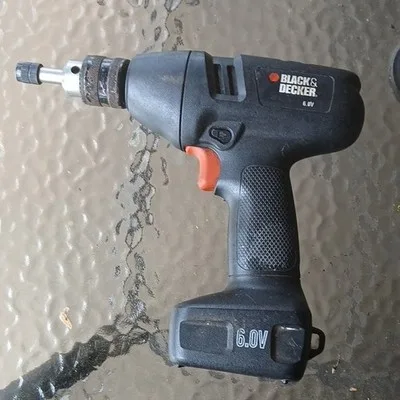
In 1979, Black & Decker released a 3.6-volt NiCd cordless drill, and it's the unit most people picture when they hear "first cordless drill." The battery was fixed into the handle. You couldn't swap it. The whole tool weighed around 4.5 pounds.
Manufacturer specs from that era list a no-load speed in the 500 RPM range and torque well under 150 in-lb.
What could it actually do? Drive a few drywall screws. Pilot holes in softwood.
Maybe a light furniture assembly in your garage. For anything resembling a framing or carpentry job, you'd still reach for a corded 10-amp drill. The runtime under load came in around 10 to 15 minutes before the NiCd pack voltage sagged and the motor stalled.
That trade-off, convenience over raw power, defined the first generation. You gained the ability to work without hunting for an outlet. You lost torque, runtime, and any chance of driving into masonry.
It was a hobbyist tool first and a tradesman's tool never. But it proved the concept, and the next decade would be all about chasing that lost power back.
The 1980s Platform Wars: Makita, Bosch, and Milwaukee Go Cordless
By 1982, Makita had launched a 7.2-volt NiCd line aimed at Japanese workshops and trades. Bosch followed with comparable 7.2 and 10.8-volt units out of Germany. Milwaukee jumped in with 10.8-volt and 14.4-volt platforms by the mid-1980s.
Each step up in voltage added a little more torque and a little more weight to the pack.
The big shift in this decade was swappable battery packs. You could carry two or three charged packs and keep working when one died. That solved the 10-minute runtime ceiling from 1979.
But the chemistry hadn't changed. You were still running NiCd cells with the same memory effect and voltage sag problems. The tools got a little stronger, a little heavier, and a little more useful.
Still not a framing tool, though.
| Year | Brand | Voltage | Battery Type | Approx. Torque |
|---|---|---|---|---|
| 1979 | Black & Decker | 3.6 V | NiCd (fixed) | ~120 in-lb |
| 1982 | Makita | 7.2 V | NiCd (swappable) | ~200 in-lb |
| 1985 | Milwaukee | 14.4 V | NiCd (swappable) | ~350 in-lb |
The Li-ion Shift: 1991 to 2004 and What Actually Changed
Sony commercialized the first lithium-ion cell in 1991, and Murata Manufacturing handled early cell production. The cell was aimed at consumer electronics first: camcorders, laptop batteries, early phones. Power tool makers watched that development closely.
By the late 1990s, 18-volt and 20-volt Li-ion platforms were hitting the market.
What actually changed was the weight-to-power ratio. A Li-ion pack delivering 18 volts and 5 amp-hours weighed roughly half what a NiCd pack of the same voltage class did. No memory effect.
No deep-discharge damage. Runtime under load jumped from 15 minutes to 60 to 90 minutes on a single pack.
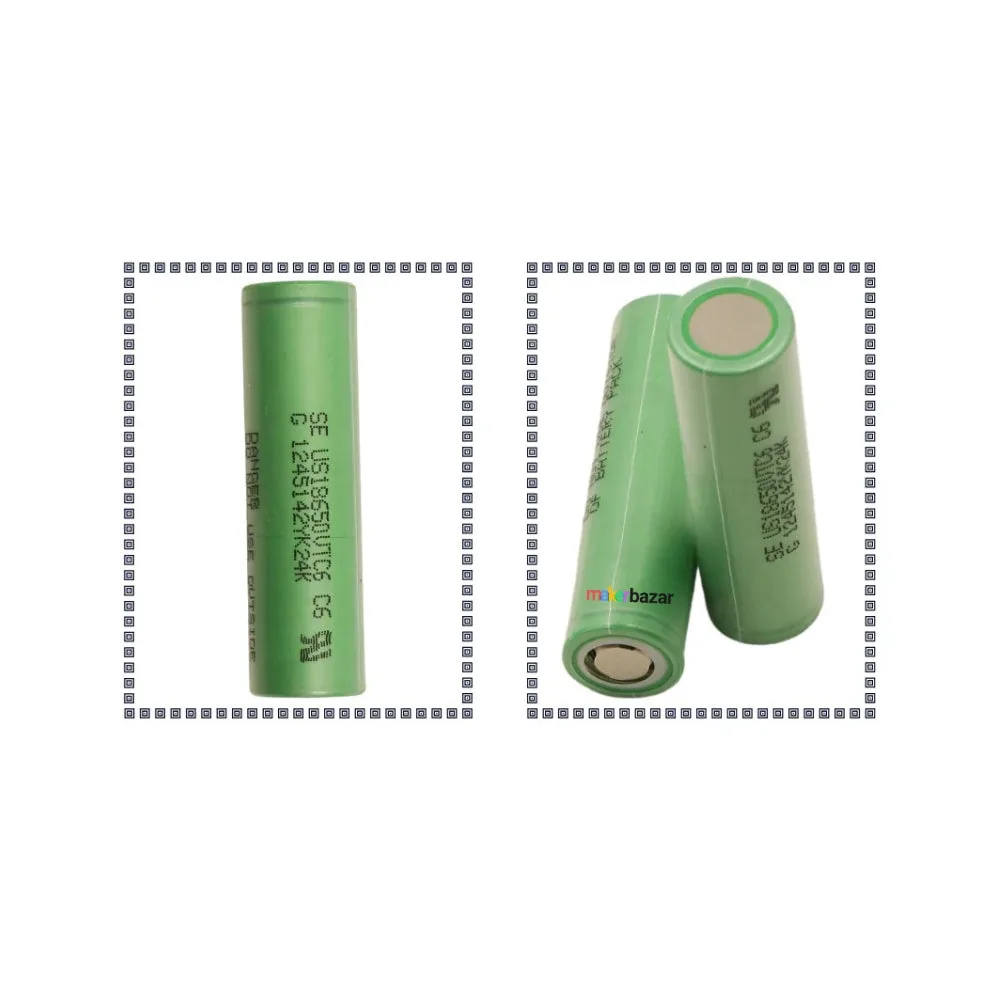
By 2004 to 2007, the 18/20-volt Li-ion platform became the default for construction trades. The corded drill started losing ground fast. You could now frame a wall on a single battery charge and not think about it.
By the Numbers: Performance Across Four Decades
The jump from 1979 to the 2020s is stark if you line up the specs side by side. Torque went from roughly 120 in-lb to over 600 in-lb in high-torque mode. Weight dropped from 4.5 pounds to under 2 pounds on compact brushless models.
Runtime under sustained load went from about 12 minutes to well over an hour.
The motor technology shifted too. Early NiCd drills used a simple brushed DC motor with a planetary gear. Modern 20-volt tools pair a brushless (electronically commutated) motor with a metal-cased gear train.
That combination cuts heat, extends battery life, and holds RPM under stall conditions. Manufacturer spec sheets from Milwaukee, DeWalt, and Makita list no-load RPM in the 0 to 1,800 range with stall torque past 600 in-lb on their top 20-volt drivers.
What Early Cordless Drills Got Wrong
The 1979 through mid-1980s units had a fundamental problem: they were toys for the trade. A 3.6-volt or 7.2-volt NiCd drill simply could not drive a #10 drywall screw into studs at production speed. The voltage sag under load meant the motor dropped RPM the moment you applied pressure.
You'd start driving, feel the tool slow, and wait for it to recover.
NiCd memory effect compounded the issue. If you regularly charged the pack at 50 percent instead of full, the cells "remembered" the shorter cycle and stopped delivering full capacity. A pack that used to last 15 minutes would drop to 8 after a few partial cycles.
Trades who relied on these tools on tight deadlines found themselves swapping packs constantly or dragging a corded unit anyway.
Li-ion solved both problems in one swap. No memory effect. Flat discharge curve.
Higher energy density per ounce. The trade-off was cost. A Li-ion pack in 1999 cost two to three times what the NiCd equivalent did.
That premium kept most trades on NiCd for a few more years until the battery price curve broke downward. One more wrinkle: the EPA classifies NiCd cells as hazardous waste because of the cadmium content, so old packs from the '80s need to go through EPA-designated disposal programs rather than the regular trash.
From Single Tool to Ecosystem: The Platform Standardization Story
The real commercial turning point wasn't a better battery. It was one battery running five tools. Makita's 18-volt LXT platform, launched around 2002, let you clip the same pack into a drill, an impact driver, a reciprocating saw, a grinder, and a work light.
Milwaukee and DeWalt built similar ecosystems on 18/20-volt Li-ion by 2005.
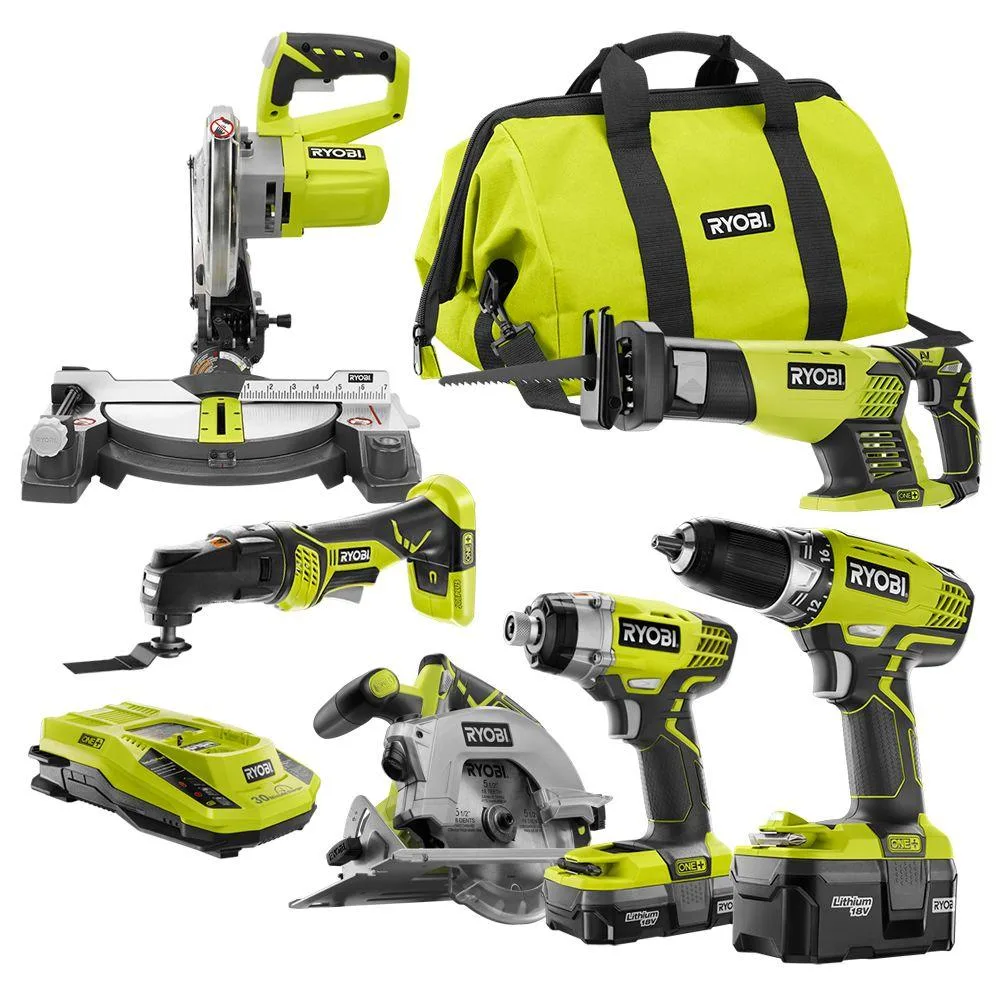
That model changed buying behavior. You no longer picked a single drill. You picked a platform and filled it out.
The battery became the anchor purchase, and every tool you added shared that one charger and one pack format. Brand lock-in followed naturally: your 18-volt Makita pack doesn't fit a Milwaukee tool, and vice versa. As of 2026, the dominant platforms sit at 18/20 volts for trades and 40 volts for high-torque industrial work, all running on Li-ion with brushless motors as standard.
The 1979 fixed-pack NiCd drill is basically a museum piece now, but the lineage is unbroken from that first 3.6-volt unit to the 20-volt brushless impact driver in your garage.
Where This History Shows Up in Your Garage Right Now
You probably have at least one tool in your shed that traces its lineage back to that 1946 GE lab bench. Grab your 18/20-volt Li-ion impact driver and look at the battery clip. That swappable pack design is the direct evolution of the fixed NiCd canister from 1979.
The brushless motor inside the tool head traces back to the simple brushed DC unit Edison first patented in 1876, just with electronics doing the commutation now instead of physical brushes.
Why your 18 V impact driver shares a lineage with a 1946 GE lab prototype
The chain is unbroken. Edison's DC motor, Schanz's 1895 hand-drill patents, Vonnegut's 1946 NiCd cell, Black & Decker's 1979 tool, the 1980s swappable-pack platforms, Sony's 1991 Li-ion, and your current 20-volt brushless system. Each step solved one bottleneck the previous generation hit.
The 1979 tool couldn't do real work. The 1985 14.4-volt NiCd could drive drywall screws. The 2004 18-volt Li-ion could frame a wall on one charge.
And the 2020s brushless 20-volt unit can run a full day of mixed tasks without a break.
If you've ever swapped a battery mid-job and kept going, you're using the exact workflow the 1980s platform makers were chasing. The only difference is energy density and motor efficiency. The concept hasn't changed in 47 years.
Frequently Asked Questions About Cordless Drill History
Who patented the first battery-powered drill?
No single person owns one patent for the whole device. The key filings stack: Edison's DC motor (1876), Schanz's hand-drill patents (1895), Vonnegut's NiCd cell at GE (1946), and Black & Decker's commercial tool (1979). Each patent built on the last.
You can trace all of them through the USPTO database.
What voltage was the original cordless drill?
The 1979 Black & Decker unit ran at 3.6 volts on a fixed NiCd pack. That translated to roughly 120 inch-pounds of torque and a 10-to-15-minute runtime under load. It was a hobbyist tool.
You could not frame a wall or drive masonry with it.
When did Li-ion replace NiCd in power tools?
The transition ran from about 1997 to 2007. Early 18-volt Li-ion tools hit the market around 1997 to 2000. By 2004 to 2007, Li-ion was the standard for trades.
NiCd packs lingered in budget and rental tools for a few more years but are essentially obsolete in new production as of 2026.
Is there a single inventor of the cordless drill?
No. It was a chain of four distinct inventions spanning 100 years. Edison made the motor.
Vonnegut made the battery chemistry. Black & Decker's engineering team made the first sellable tool. Sony and Murata made the Li-ion cell that made it all work.
No one name covers the whole thing.
Why did it take so long after the battery was invented?
The 1946 NiCd cell had the right chemistry but the wrong energy density for a power tool. It took roughly three decades of cell engineering to push voltage and capacity high enough. Then another 20 years to move from fixed NiCd packs to swappable Li-ion.
The tool was always waiting on the battery to catch up.