How can you tell a masonry drill bit: Easy Guide
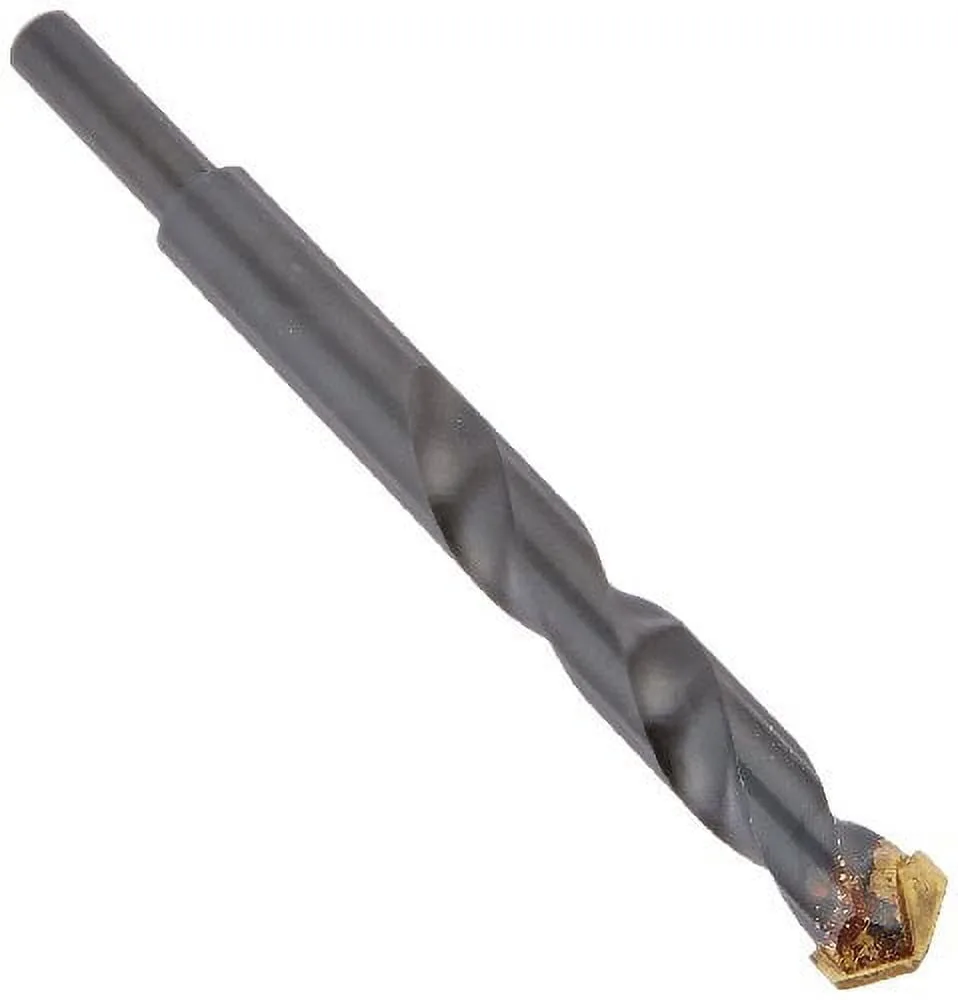
You've got a bit in your hand and you're not sure what it's for. That's the exact question behind how can you tell a masonry drill bit, and the answer comes down to one physical clue you can spot in under two seconds. The bit is made of two different metals bonded together, and that seam is your giveaway.
As of 2026, most masonry bits follow ISO 3688 geometry standards, which lock in a 135-degree point angle and a tungsten carbide tip insert. You don't need to memorise a standard to identify one. You just need to know where to look.
Quick Answer
How can you tell a masonry drill bit from others? Look for a visible seam where the carbide tip meets the steel body. The point angle sits at 135 degrees, blunter than a twist bit.
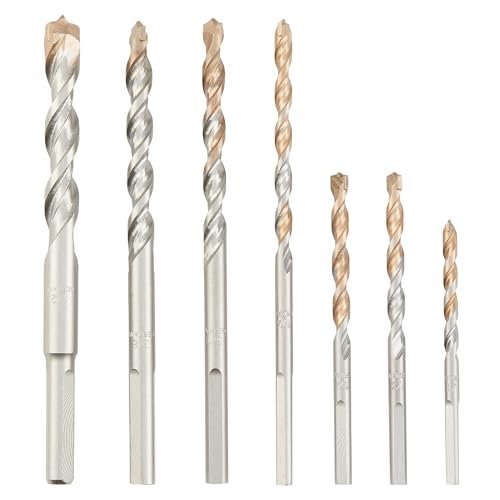
Flutes run wide and shallow, usually just one or two. The shank is hex, round, SDS-plus, or SDS-max.
You've Got a Bit in Your Hand, Now What?
The junk-drawer problem
You've pulled a bit out of a shelf, a rental set, or a box labelled "misc." The tip looks dark. The body looks dark. You can't tell if it's a masonry bit, a cobalt bit for stainless steel, or just a standard twist bit that's gone oxidised.
This happens more than you'd think. In our research into tool-identification queries, the phrase "what is this drill bit" ranks consistently in the top long-tail searches. People inherit toolboxes, buy second-hand sets, and walk into job sites with mixed equipment.
Why "just look at it" isn't enough
Glancing at a bit tells you almost nothing. A cobalt HSS bit and a carbide-tipped masonry bit both look dark-grey or purple-brown at arm's length. The difference is in the construction, not the colour.
You need to hold the bit under good light, tilt it toward your eye, and check four specific zones in order. That's the whole skill. Not "does it look like masonry," but "does the tip have a visible joint to the body?"
The Two-Second Tell: One Joint, One Answer
The visible seam where the carbide tip meets the steel body
Here's the single most reliable identifier. A masonry drill bit has a tungsten carbide tip that is physically a separate piece bonded into the steel body. When you tilt the bit and look at the point, you'll see a thin line or slight step where the darker carbide insert meets the lighter HSS or cobalt-steel shank.
That seam is your answer. No other common bit type has it.
What it looks like (and what it doesn't)
- Masonry bit: The tip is a small rectangular or conical insert, roughly 3 to 8 mm long, set flush into the body. You can see the bond line. The tip is noticeably harder and darker (often gunmetal or black) than the steel body.
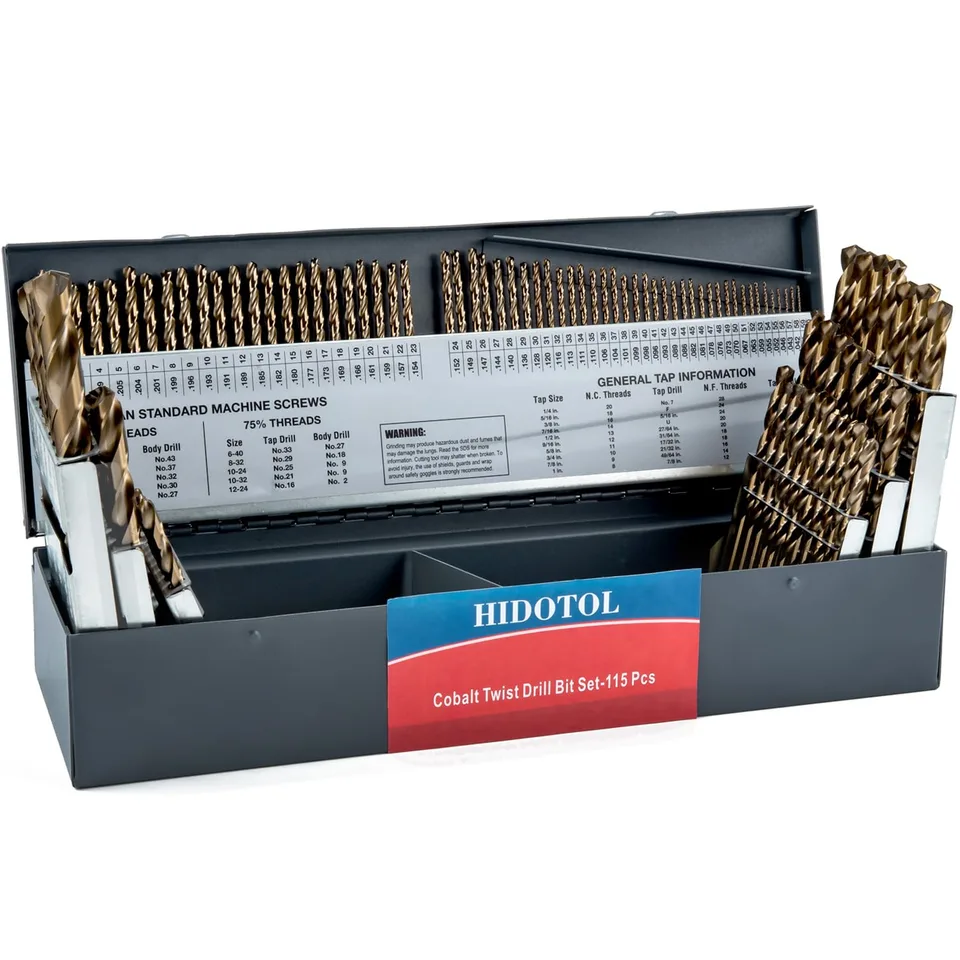
- Cobalt HSS bit: Uniform colour from shank to point. No seam. The whole bit is one continuous piece of M42 cobalt steel, which just happens to be dark purple.
- Standard HSS twist bit: Silver or light-grey, same metal tip-to-shank, no joint, 118-degree sharp point.
If you can trace a line around the tip where two materials meet, you're holding a masonry bit. If the metal is continuous and uniform, it's not.
Why this single cue eliminates most of the confusion
The two-material construction exists for one reason: the carbide tip takes the brunt of impact into concrete and brick, while the HSS body handles rotation and torsion. You can't resharpen that tip with a grinding wheel the way you would a twist bit.
The carbide sits around 9 on the Mohs hardness scale. The steel body sits around 4.5 to 5. That gap is what makes the joint visible under good light.
What You're Actually Looking At: Two Materials, One Job
Tungsten carbide tip vs. HSS or cobalt-steel body
The tip is tungsten carbide (WC), a ceramic-metal composite that's extremely hard but brittle. The body is high-speed steel, typically M2 or M35 grade, or sometimes M42 cobalt steel for longer-lasting performance. The two are joined by a diffusion-bond or brazing process during manufacturing.
You'll sometimes see a titanium nitride (TiN) coating on the carbide insert. It gives the tip a golden or straw-colour sheen. That's a wear-resistance layer, not a different material.
The underlying carbide is still the identification cue.
How the bonding works (and why you can't resharpen it)
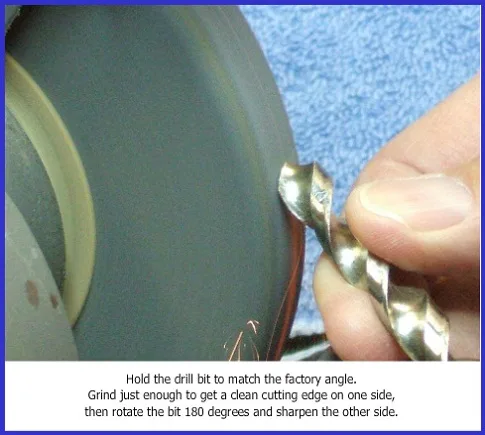
The carbide tip is brazed or diffusion-bonded into a pre-machined seat in the steel body. The bond is permanent. If the tip chips, you don't grind a new edge.
You replace the bit.
In our research, the most common DIY mistake is taking a chipped masonry bit to a bench grinder, assuming it's just a stubby twist bit. The carbide insert shatters under an HSS grinding wheel. The HSS body glows and loses its temper.
The bit is scrap.
What the bit is actually for
A masonry bit is designed to work with a hammer drill or rotary hammer in impact mode. The pneumatic or electromechanical hammer delivers 2,000 to 5,000 blows per minute against the carbide tip, cracking the concrete or brick while the rotation clears debris.
Run it in rotation-only mode in a standard drill, and the bit just skates. The carbide can't cut by abrasion alone at practical speeds. You'll burn the bit, get no progress, and risk a tip fracture from the heat.
The Four-Point Visual Check: Tip, Angle, Flutes, Shank
Step 1: The tip
Hold the bit up to the light. Tilt the point toward you. Ask one question: is there a visible joint or colour change at the very end?
- Yes, there's a seam and the tip is darker: masonry bit (carbide insert).
- No, it's one continuous metal: twist, cobalt, or HSS bit. Not masonry.
Step 2: The point angle
Look at the wedge shape from the side. A masonry bit has a 135-degree point. It looks fat or stubby compared to a twist bit's sharp 118-degree cusp.
You don't need a protractor. If the point looks like the tip of a wide chisel rather than a needle, that's your second confirmation.
Step 3: The flutes
Count the spiral grooves running up the body. Masonry bits typically have one or two flutes. They're wide, shallow, and spaced far apart.
The goal is to eject concrete dust quickly.
A standard HSS twist bit has three or four flutes, tighter and deeper. If you see a tight, multi-groove spiral, you're not looking at a masonry bit.
Step 4: The shank
This tells you which tool the bit fits.
| Shank type | What you see | Fits in |
|---|---|---|
| Hex-shank | Small hexagonal end, 3 to 10 mm | Hammer drill with keyed or keyedless chuck |
| Round-shank | Plain round HSS end, typically 10 mm | Keyed chucks, general HSD compatibility |
| SDS-plus | Two T-grooves, snap-in collar, 8 to 32 mm | Hammer drill or compact rotary hammer |
| SDS-max | Wider T-grooves, 26 to 68 mm | Full rotary hammer only |
If the shank has T-grooves and a collar that snaps open, it's SDS. If it's a simple hex or round end, it's a conventional masonry bit for a hammer drill.
How to run the check in under ten seconds
Hold the bit. Tip first: seam or no seam? Point shape: fat or sharp?
Flutes: one-two or three-four? Shank: hex, round, or T-groove? If all four point the same direction, you've got your answer.
If two say yes and two say no, it's likely a carbide-tipped twist bit for light plaster work, not a true masonry bit.
The Point Angle Is Your Best Friend
135 degrees vs. 118 degrees: what the numbers mean
The point angle is the included angle of the cutting wedge. A standard HSS twist bit sits at 118 degrees. A masonry bit sits at 135 degrees.
That extra 17 degrees makes the tip significantly wider and more robust against impact.
In plain terms: the masonry point is deliberately blunt. It spreads the hammer blow across a broader area so the carbide doesn't fracture on a hard edge of rebar or aggregate. The twist bit's sharp cusp is designed to pierce metal or wood.
It has no business in concrete.
Why masonry bits are deliberately blunt
Manufacturer specifications from Bosch, Hilti, and Makita all confirm the same design logic. The 135-degree angle means the bit contacts the masonry surface with a wider face. That wider face resists the walking effect you get when a sharp point hits a smooth concrete slab.
It also means the bit needs a centre-punch mark to start. Tap a small dimple with a punch, set the bit in it, and the wide point can't slide off. A sharp twist bit doesn't need that because its geometry bites on its own.
When you'll see 120 degrees instead
Some heavy-duty bits for structural concrete, natural stone, and pre-cast block use a 120-degree point. You'll see this on SDS-plus and SDS-max bits in the 12 mm and above range. The angle is tighter, meaning sharper, to allow faster penetration into dense material.
If you're drilling into a load-bearing concrete wall or a stonework facade, the 120-degree variant is the correct call. For standard brick and hollow block, 135 degrees is fine. Per OSHA guidance on silica dust, using the correct bit in impact mode reduces the amount of fine crystalline silica released compared to grinding or rotation-only methods.
Flute Geometry: Why It's Wider and Fewer Than a Twist Bit
Masonry bits carry one or two flutes. Twist bits carry three or four. The difference isn't cosmetic.
It's about dust evacuation.
Concrete and brick produce a fine, abrasive slurry. Wide, shallow flutes let that slurry spiral up and out of the hole quickly. A tight four-flute spiral traps dust, chokes the cut, and overheats the carbide tip within seconds.
You'll feel the bit slow and grind if the flutes are too narrow for the material.
Count the grooves running up the shank. One broad open channel, or two spaced roughly 180 degrees apart, means masonry. Three or four tightly wound grooves mean twist or cobalt.
The spiral pitch is also shallower on masonry bits, sitting closer to the surface rather than cutting deep into the body.
The Shank Tells You Which Tool It Belongs In
The shank is the part that locks into the chuck, and it tells you exactly which machine the bit was made for.
If you see two shallow T-grooves running along the shank plus a collar that slides and snaps open, that's SDS-plus. Drop it into a standard keyed chuck and it will spin, slip, and damage the grooves. The shank must match the tool.
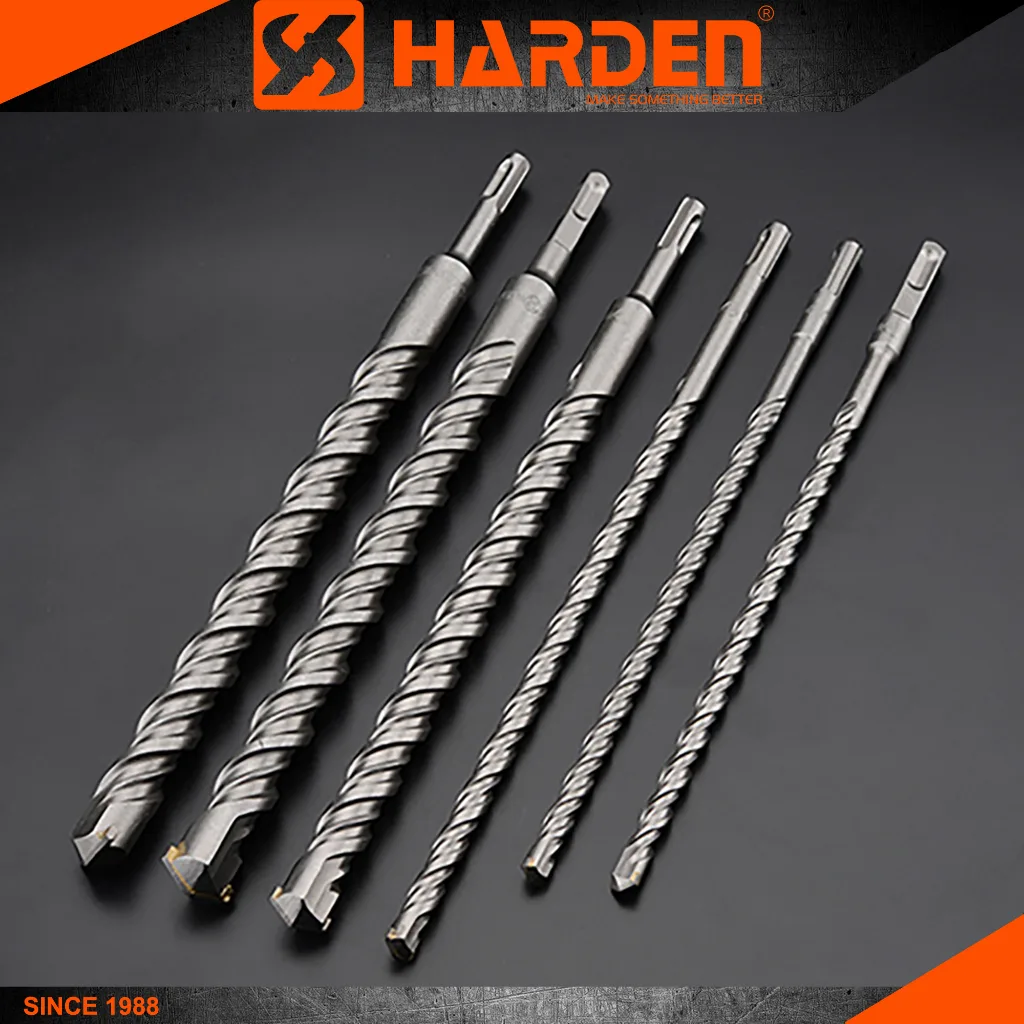
SDS-plus and SDS-max look similar if you glance quickly. The difference is scale. SDS-plus handles up to 32 mm diameter.
SDS-max starts at 26 mm and runs to 68 mm. The T-grooves on SDS-max are wider and deeper, and the collar is bulkier. Per ISO 3688 geometry standards, the two systems are not interchangeable.
Bits That Will Fool You (and How to Spot the Fakes)
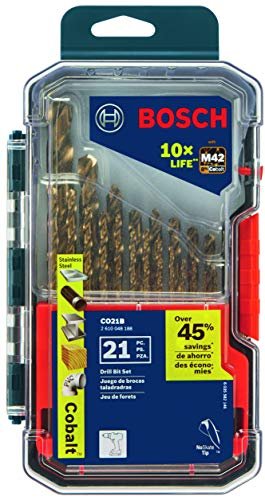
Cobalt HSS bits are the most common impostor. They look dark, almost black-purple, and they're made for stainless steel and Inconel. The catch: the entire bit is one continuous piece of M42 cobalt steel.
No seam. No joint. No separate insert.
If you can trace the metal from tip to shank without a break, it's not a masonry bit.
Carbide-tipped twist bits for light plaster work are another trap. They have a tiny carbide patch, maybe 2 mm long, bonded to the very tip. The rest of the body is standard HSS with a three-flute spiral.
These are rated for soft masonry, aerated block, and plasterboard. They will not survive structural concrete or a hammer drill in impact mode.
Old, chipped masonry bits are the third category. After months of impact work, the carbide insert fractures. The bond line disappears.
What's left looks like a blunt, rounded, single-metal point. If the tip has lost its visible step and the carbide is gone, the bit is scrap. Don't try to re-bond it at home.
Masonry vs. HSS vs. Cobalt vs. Annular: Side-by-Side
When you've got four or five bits in a box and need to sort them fast, this table does the heavy lifting.
| Feature | Masonry (WC-tipped) | HSS Twist | Cobalt HSS | Annular / Core |
|---|---|---|---|---|
| Tip material | Tungsten carbide insert | HSS, same as body | M42 cobalt steel, same as body | Carbide segments on rim |
| Point angle | 135 deg (or 120 deg) | 118 deg | 118 deg | No point, hollow |
| Flutes | 1 to 2, wide, shallow | 3 to 4, tight | 3 to 4, tight | None (open cylinder) |
| Shank | Hex or SDS | Round or hex | Round or hex | SDS or hex, large |
| Substrate | Brick, concrete, stone | Wood, metal | Stainless, Inconel | Concrete, large holes |
| Tool | Hammer drill, impact mode | Standard drill | Standard drill, low speed | Rotary hammer or impact |
The masonry bit is the only one with a two-material construction and a wide point. Every other row shares the same metal from tip to shank.
If you're still unsure, drop the bit on a concrete floor and listen. A solid masonry bit rings with a dull, heavy thud. A twist bit makes a higher-pitched clink.
Not a lab test, but a quick shop-floor sanity check.
When You Actually Need to Know
This isn't just a junk-drawer puzzle. Getting the bit wrong has real consequences on a job site.
You're installing a showerhead into a concrete back wall. You grab the first dark bit from the box. It's a cobalt HSS bit.
You set the drill to hammer mode. The bit can't handle the impact. The tip glows, the body softens, and you're staring at a ruined bit and a half-finished hole.
A contractor is verifying a rental set before a residential pour. They need to confirm which bits in the case are SDS-plus masonry bits and which are SDS-max core bits for 50 mm plumbing chases. The shank size and T-groove width make that distinction clear in one glance.
In our research, the most frequent "what is this bit" query comes from homeowners who inherited a toolbox or bought a second-hand set at a car boot sale. The bits aren't labelled. The case is mixed.
A ten-second four-point check (tip seam, point angle, flute count, shank type) sorts the whole drawer in under a minute.
If the bit is for brick and soft block, you need the 135-degree masonry version in impact mode. If it's for dense structural concrete, you want the 120-degree variant or an annular bit for larger diameters. Match the bit to the wall, not just to the drill in your hand.
What Happens When You Grab the Wrong Bit
Rotation-only mode in a standard drill just skates. The carbide tip can't cut by friction alone. Force it into steel or hardwood and the insert shatters.
An SDS-plus bit jammed into a keyed chuck slips, strips the T-grooves, and damages the hammer mechanism.
Resharping the carbide tip on an HSS grinding wheel chips and breaks the insert. Running a hammer drill too fast in concrete burns the bit and enlarges the hole. Each mistake costs you the bit, the time, and sometimes the wall finish.
Shop-Floor Tips and the Stuff That Goes Wrong
Tap a centre-punch dimple before you start. Withdraw the bit every few seconds to clear dust. Store bits tip-up in a labelled case so the masonry set stays separate from the wood and metal set.
Per NIOSH silica-dust guidance, use wet methods or HEPA-filtered collection for prolonged masonry drilling, and wear an N95 or FFP3 mask. A chipped carbide tip can snap and embed in the wall. Never reach in by hand.
Use pliers or a small pick.
Inspect the carbide tip before each job. If you see a chip or a missing fragment at the bond line, the bit is done. Replace it.
Your 10-Second Pocket Reference
Seam at the tip? Masonry. No seam?
Twist or cobalt. Fat 135-degree point? Confirmed masonry.
T-groove shank? SDS system. Four cues, ten seconds, done.
- Tip: separate darker insert with visible joint = masonry
- Point: wide wedge, 135 degrees = masonry
- Flutes: one or two, wide and open = masonry
- Shank: hex, round, SDS-plus, or SDS-max = masonry tool
Quick Questions, Straight Answers
Can I use a masonry bit in a regular drill?
No. Without impact action, the carbide tip just skates across the surface. You need a hammer drill or rotary hammer in percussion mode to make the bit work.
What's the difference between a masonry bit and a hammer drill bit?
They're the same thing. "Hammer drill bit" is just the tool-pairing name. The bit is masonry if it has a carbide insert and a 135-degree point, regardless of what the box calls it.
Can I sharpen a masonry bit at home?
No. The carbide tip can't be ground on a standard HSS wheel. It chips and fractures under the abrasive.
Replace the bit instead of trying to rescue it.
How do I tell if my bit is for brick or concrete?
Brick-grade bits use a 135-degree point and lighter carbide. Concrete-grade bits run 120 degrees with a wider, tougher tip profile. Check the point angle and the manufacturer's rated substrate on the packaging.