Is a Hammer Drill the Same as an Impact Drill: Easy guide
You've probably stared at a cordless drill, flipped the mode switch to the hammer icon, and wondered: is a hammer drill the same as an impact drill? The short answer is no, and the two tools use completely different internal mechanisms. One hammers the bit axially into the wall.
The other hammers the rotation itself to build torque on a screw head.
As of 2026, a mid-range 18-volt cordless hammer drill delivers roughly 1.5 to 3 joules of energy per axial blow at up to 3,000 blows per minute. An impact drill in the same class produces rotational torque spikes of 100 to 600 in-lb through a cam-and-pawl mechanism. Different physics, different jobs.
Here's where each tool actually earns its place.
Quick Answer
A hammer drill is not the same as an impact drill. They use different internal mechanisms entirely. A hammer drill drives axial blows into masonry.
An impact drill hammers rotational torque for fastening. Confusing them means slower work and worn bits.
No, They Aren't the Same. The Hammer Button on Your Drill Is Lying to You
The biggest source of confusion is the little hammer pictogram on the mode dial of nearly every drill sold in the US. That symbol just means "percussive mode is available." It does not tell you which mechanism is inside. A standard impact drill with a hammer function uses a cam-and-pawl to interrupt the gear train and create torque pulses.
A true hammer drill contains a dedicated piston that slams the bit forward along its axis, independent of rotation.
Manufacturer specs confirm the split. Makita, DeWalt, and Milwaukee list "axial blow energy" in joules for hammer drills but "peak torque" in in-lb for impact drills. Different unit, different job.
If the box only shows a torque rating, you're looking at an impact tool.
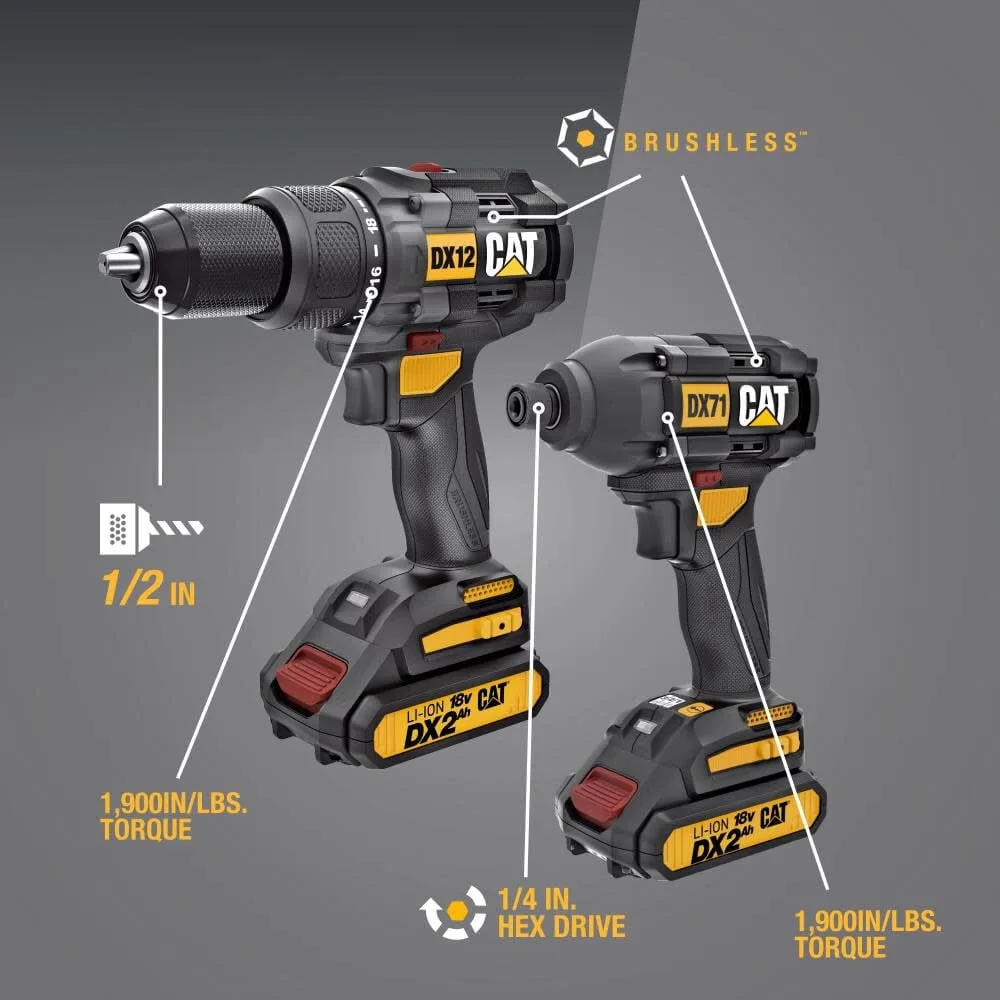
The naming is messy, and it's not your fault. The industry has layered "impact," "hammer," and "percussive" over overlapping tool classes for decades. The fix is simple: check the mechanism type in the spec sheet before you buy.
Inside a Hammer Drill: How Axial Percussive Blow Actually Works
A hammer drill houses a small piston, either gear-driven or pneumatically powered, that slides back and forth along the bit's axis. The piston fires independently of the rotation. The bit can be spinning, not spinning, or counter-rotating while the blows still land.
A typical 18-volt model delivers 1.5 to 3 joules per strike. Pneumatic rotary hammers push 8 to 15 joules.
Gear-driven hammers are cheaper and lighter, but they lose blow force as the motor slows under load. Pneumatic hammers keep their energy-per-blow steady. That's why pros working in structural concrete prefer them.
The tradeoff is weight and price.
You'll notice the bit interface is different, too. Hammer drills use either a keyed 1/4-inch or 3/8-inch Jacobs chuck, or a quick-change SDS-plus collar. The SDS system locks the bit with two pins into two longitudinal grooves, holding it rigidly on the sides while it slides freely along the axis.
That sliding freedom lets the axial blows transfer into the masonry instead of bouncing back into your wrist.
Per OSHA guidance on crystalline silica exposure in construction, hammer-drilling concrete or brick generates respirable dust that hits regulatory limits fast. If you're doing more than about ten minutes of dry masonry drilling a day, you need local exhaust or wet suppression in place.
Inside an Impact Drill: The Cam-and-Pawl Mechanism That Isn't a Hammer at All
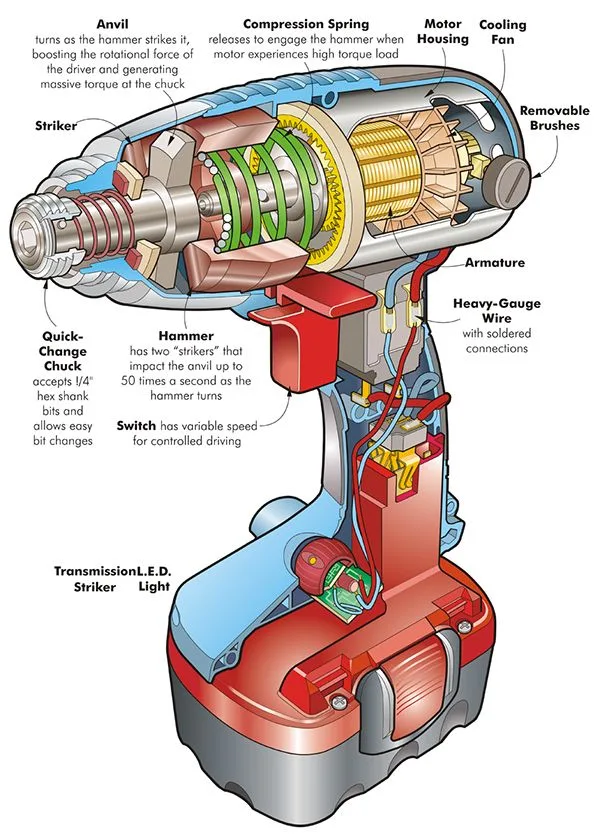
An impact drill's "hammer" mode is a completely different animal. Inside the gearbox, a spring-loaded cam and a set of pawls sit between the motor and the output shaft. When torque resistance builds, the cam slips, the spring compresses, and the pawls snap back, delivering a sharp rotational jolt.
That jolt multiplies peak torque well beyond what the motor alone can push.
The whole thing stays in the drive line. No axial piston. No independent blow.
The "impact" is a rotational hiccup, not a forward hammer strike. That's why an impact drill is brilliant for driving lag bolts or self-tapping screws into masonry, but useless for fracturing concrete. You're grinding, not breaking.
Key traits that set an impact drill apart:
- Output measured in torque (in-lb), not joules per blow
- Percussive action is rotational, not axial
- Standard keyed or hex chuck, no SDS interface
- Best paired with wood, metal, or masonry screw bits
- Typical peak torque: 100 to 600 in-lb depending on class
If your job is hanging a TV bracket on drywall studs or driving anchor screws into brick, the impact drill is the right call. If you're boring a 5/8-inch hole through a cinder block to set a sleeve anchor, you need the axial blows of a hammer drill or a rotary hammer.
Side-by-Side: Hammer Drill vs. Impact Drill vs. Rotary Hammer
This table pulls together the core specs so you can see the differences at a glance. Numbers reflect mid-tier 18-volt cordless platforms available as of 2026.
| Spec | Hammer Drill (gear-driven) | Impact Drill / Driver | Rotary Hammer (pneumatic) |
|---|---|---|---|
| Percussive mechanism | Axial piston, gear-driven | Cam-and-pawl, rotational | Axial piston, air-cylinder |
| Energy per blow | 1.5 to 3 J | None (torque only) | 3 to 15+ J |
| Blow rate | 0 to 3,000 BPM | N/A | 0 to 3,000 BPM |
| Peak torque | 50 to 150 in-lb | 100 to 600 in-lb | 30 to 80 in-lb |
| Max RPM | 0 to 1,300 | 0 to 2,200 | 0 to 1,000 |
| Bit interface | Keyed / SDS-plus | 1/4" hex or keyed | SDS-plus or SDS-max |
| Typical weight | 3 to 5 lb | 1.5 to 3 lb | 6 to 12 lb |
| Best material | Brick, block, tile, plaster | Wood, metal, masonry screws | Structural concrete, stone |
| Price band (cordless) | $100 to $250 | $60 to $150 | $150 to $500+ |
These three tools sit on a spectrum of percussive energy. The impact drill has no axial blow at all. The gear-driven hammer drill sits in the middle.
The pneumatic rotary hammer sits at the high end. You don't reach up the spectrum for a job the lower tool can handle. And you don't bring a rotary hammer to a drywall job.
When a Hammer Drill Is the Right Tool and When It Fails You
A hammer drill is the go-to for residential and light commercial masonry work. You're drilling into brick, concrete block, tile, or plaster. You're setting sleeve anchors, wedge anchors, or Ricochet anchors.
You need a clean, round hole that grips the anchor sleeve properly.
It also works when you need rotation without the hammer. Flip the mode switch and the same tool doubles as a standard drill for wood and light metal. One tool, two jobs.
That's why it's the default in a homeowner's toolbox.
Where it starts to fail:
- Structural concrete (slabs, columns, rebar): The gear-driven piston can't keep up. You need a pneumatic rotary hammer for consistent blow energy and 3/4-inch-plus diameters.
- Deep holes (beyond 12 inches): Heat builds up in the bit and the tool. A rotary hammer with a dust-extraction port handles depth better.
- Soft materials (wood, drywall, thin metal): The axial blows spall and crack the surface. Switch to rotation-only or use a standard impact drill.
- Overtightening anchor bolts: Hammer drills don't deliver sustained high-peak torque. The bit cam-outs or the sleeve strips.
Rule of thumb: if the material is softer than a cinder block, you don't need the hammer. If the hole is bigger than 3/4 inch or the concrete is structural, you need more than a gear-driven hammer. Match the tool to the material and the diameter.
When an Impact Drill (or an Impact Driver) Beats the Hammer Every Time
You don't need axial blows to drive a lag bolt into a post or thread a masonry screw into a cinder block. An impact driver, with its 300 to 600 in-lb peak torque and 1/4-inch hex quick-release bit holder, gets the fastener seated in seconds.
The hammer drill's torque rating, typically 50 to 150 in-lb, is just not enough for sustained fastening. You'll cam-out the bit, strip the driver head, or fatigue the battery cycling between rotation and the percussive piston. The impact driver was designed for this exact problem.
Its anvil-and-hammer mechanism delivers rotational impact, so the bit stays seated on the screw head while torque spikes build. No cam-out. No stripped heads.
If your job is hanging drywall, assembling a deck, or setting anchor screws, the impact driver is the faster, lighter, cheaper tool. The hammer drill goes back in the drawer.
The Four Mistakes That Crack Masonry, Strip Bits, and Kill Batteries
- Grinding a twist bit into concrete. You'll burn the carbide tip in under 30 seconds and walk the bit off-center. Use a proper masonry bit with a split-point or tungsten-carbide tip. The axial blows fracture the material. The rotation clears the chips.
- Leaving hammer mode on for wood or drywall. The piston spalls the surface, cracks a stud, or blows out an anchor hole wider than it should be. Flip the switch to rotation-only before you touch soft material.
- Forcing the tool into masonry. Light, steady feed pressure is all you need. The blows do the work. If you're leaning on it, you're stripping the bit's tip and shocking the gearbox. Let the tool run at its natural rate.
- Running a gear-driven hammer below 30 percent charge. Blow energy collapses as voltage sags. You go from 2.5 joules to maybe 0.8 joules, and the bit just vibrates against the wall. Swap packs early. Don't wait for the last LED.
Each of these costs you bit life, tool life, and time. Most are fixable with a mode switch and a two-second pause before you start cutting.
Bit, Chuck, and SDS Compatibility: Why You Can't Just Bolt a Twist Bit Onto an SDS Plus Chuck
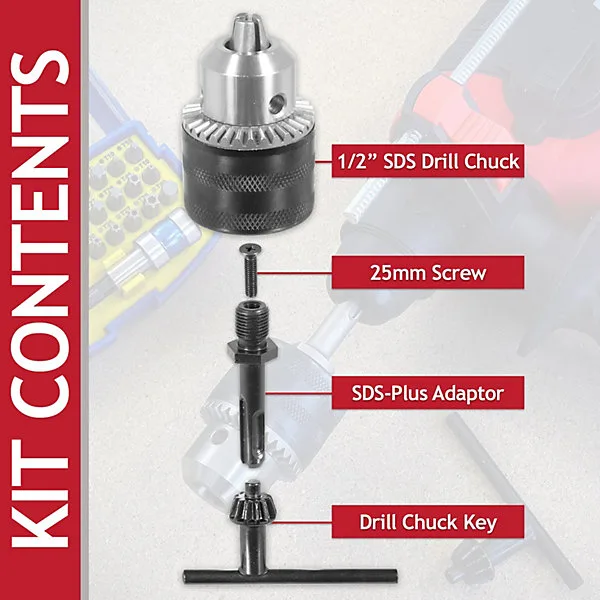
Short answer: you can't, and trying will not hold the bit. An SDS-plus bit has two longitudinal grooves and two transverse slots along its shank. The chuck grips those slots with two locking pins while allowing free axial slide.
A standard twist bit has a smooth shank. It sits in the SDS chuck loose, spinning without any percussion transfer. Zero blow energy reaches the cutting face.
The bit just wobbles and grinds.
Manufacturers sell adapters (a small metal sleeve with a keyed outer end and an SDS-plus inner end) that let you run 1/4-inch hex bits in an SDS-plus tool. They work for light masonry, but the adapter adds flex and reduces blow transfer by roughly 15 to 20 percent. For serious work, buy bits in the native SDS-plus or SDS-max interface.
The DIN 44379 standard governs groove widths, pin positions, and shank tolerances for both SDS-plus and SDS-max. If your bit or chuck comes from a different standard, the mechanical fit is off. You'll feel a slight wobble before you even start drilling.
What the Numbers Actually Mean: Blow Energy, Torque, RPM, and Weight in Practice
Joules-per-blow is the single most important spec on a hammer tool. Here's how it translates to real work:
- 1.5 to 3 J (light 18-volt gear-driven): Drills into brick, block, and tile. A 3/8-inch masonry bit in a cinder block takes 20 to 40 seconds.
- 3 to 5 J (mid-range cordless): Handles 1/2-inch to 5/8-inch holes in brick and soft concrete. The carbide tip stays sharp for 50+ holes instead of 15.
- 8 to 15+ J (SDS-max pneumatic): Structural concrete, rebar, stone. A 3/4-inch hole in a reinforced slab drops to 10 to 15 seconds. Operator fatigue drops noticeably.
RPM matters less than you'd think. A 1,300 RPM hammer drill cutting into concrete does most of its work through the blows, not the rotation. The RPM just clears chips.
An impact driver at 2,200 RPM is all about rotation. Blow energy and torque separate the two.
Weight is the underappreciated factor. A 4-pound hammer drill is comfortable for 20 holes. A 9-pound SDS-max rotary hammer makes your shoulder ache after 40.
If the job is a one-off shelf bracket, the lighter tool wins on comfort. If you're running conduit through a slab all day, the heavier pneumatic tool's consistent blow energy saves your wrists more than it costs your shoulder.
Vibration, Silica Dust, and the Safety Rules Most Tool Manuals Bury
A typical hammer drill in hammer mode emits 3 to 6 m/s2 of hand-arm vibration. NIOSH and ISO 11331 set reference levels for exposure. Prolonged work above 2.5 m/s2 raises your risk of hand-arm vibration syndrome, the condition that starts with numbness and white fingers and progresses to tendon damage.
Practical rule: if you're hammer-drilling for more than 30 minutes a day, rotate hands, use the anti-vibration handle, and take a break every 10 to 15 minutes. The tool's gel-core dampening helps, but it's not a substitute for pacing.
Silica is the other big one. Per OSHA's construction standard (29 CFR 1926.102), any task generating respirable crystalline silica above the 50 μg/m3 action level requires wet suppression or local exhaust. Dry hammer-drilling concrete for even a short period can spike past that limit fast.
An N95 helps, but it's not a substitute for engineering controls. If you're drilling in a closed garage, open a window, clip a HEPA shop vac to the tool's dust port, and swap masks hourly. The NIOSH occupational exposure database lists full chemical profiles and exposure limits for silica dust.
These are not footnotes. They're the difference between a clean drill hole and a chronic lung or circulatory problem showing up in five years.
What to Buy by Job: Material, Hole Diameter, and Anchor Type Decided
This is where the comparison stops being academic. You match the tool to the material and the hole size.
| Material / Job | Hole size | Right tool |
|---|---|---|
| Drywall, wood, thin metal | Any | Impact driver or standard drill |
| Brick, cinder block, tile | 3/16" to 5/8" | Gear-driven hammer drill |
| Structural concrete, rebar | 1/2" to 1 1/4" | Pneumatic rotary hammer (SDS-max) |
| Driving masonry or lag screws | N/A | Impact driver |
Softer than block and under 3/8 inch? The impact driver or a plain drill handles it. Concrete and over 3/4 inch?
You need the rotary hammer. Everything in between is hammer-drill territory.
FAQs That Keep Coming Up in the Workshop
Can I use a hammer drill to drive screws?
You can, but you shouldn't. The axial blows cam-out the bit and strip the head. An impact driver holds the bit seated while torque spikes build.
Faster, cleaner, and it won't wreck your fasteners.
Does the hammer button on an impact drill make it a hammer drill?
No. That switch engages a rotational cam-and-pawl, not an axial piston. You get torque spikes, not forward blows into the wall.
It's a fastening aid, not a masonry-breaking tool.
What bit do I use in an SDS-plus chuck?
Only SDS-plus masonry bits with the two-groove shank. A twist bit will not lock in. If you must run a hex bit, buy a keyed-to-SDS adapter, but expect a 15 to 20 percent drop in blow transfer.
Why does my hammer drill lose power below half charge?
Gear-driven pistons rely on motor speed. As voltage sags, RPM drops and blow energy collapses. The tool still spins, but the blows turn into weak taps.
Swap the pack at 30 percent, not at the last LED.
The 10-Second Decision Guide: Pick the Right Tool Before You Plug In
Look at the wall. Ask three things in order.
Material softer than brick? Grab the impact driver or a standard drill. Done.
Brick, block, tile, or light concrete? Gear-driven hammer drill, SDS-plus bit, light feed. You're set.
Structural concrete, rebar, or a hole over 3/4 inch? Pneumatic rotary hammer, SDS-max. No shortcuts.
One tool per job. Do not stretch a gear-driven hammer into a rebar hole, and do not bring a rotary hammer to a drywall stud. The right tool makes the hole in seconds.
The wrong one takes minutes and costs you the bit.